On-Chain Metrics

Miner Revenue (Block Rewards): Bitcoin Issuance & Miner Incentive Analysis

,
December 23, 2025
7 min read
Powered by Block Horizon proprietary Bitcoin datasets.

TL;DR

  • Miner Revenue (Block Rewards) shows how much BTC miners earn only from newly issued coins.
  • High revenue = strong miner incentives, higher hash rate, and stronger network security.
  • Revenue drops instantly after halvings, forcing miners to adapt or exit.
  • Over time, this metric reveals whether Bitcoin can sustainably transition from subsidies to fees.
  • If you want to understand Bitcoin’s economic backbone, this chart matters.

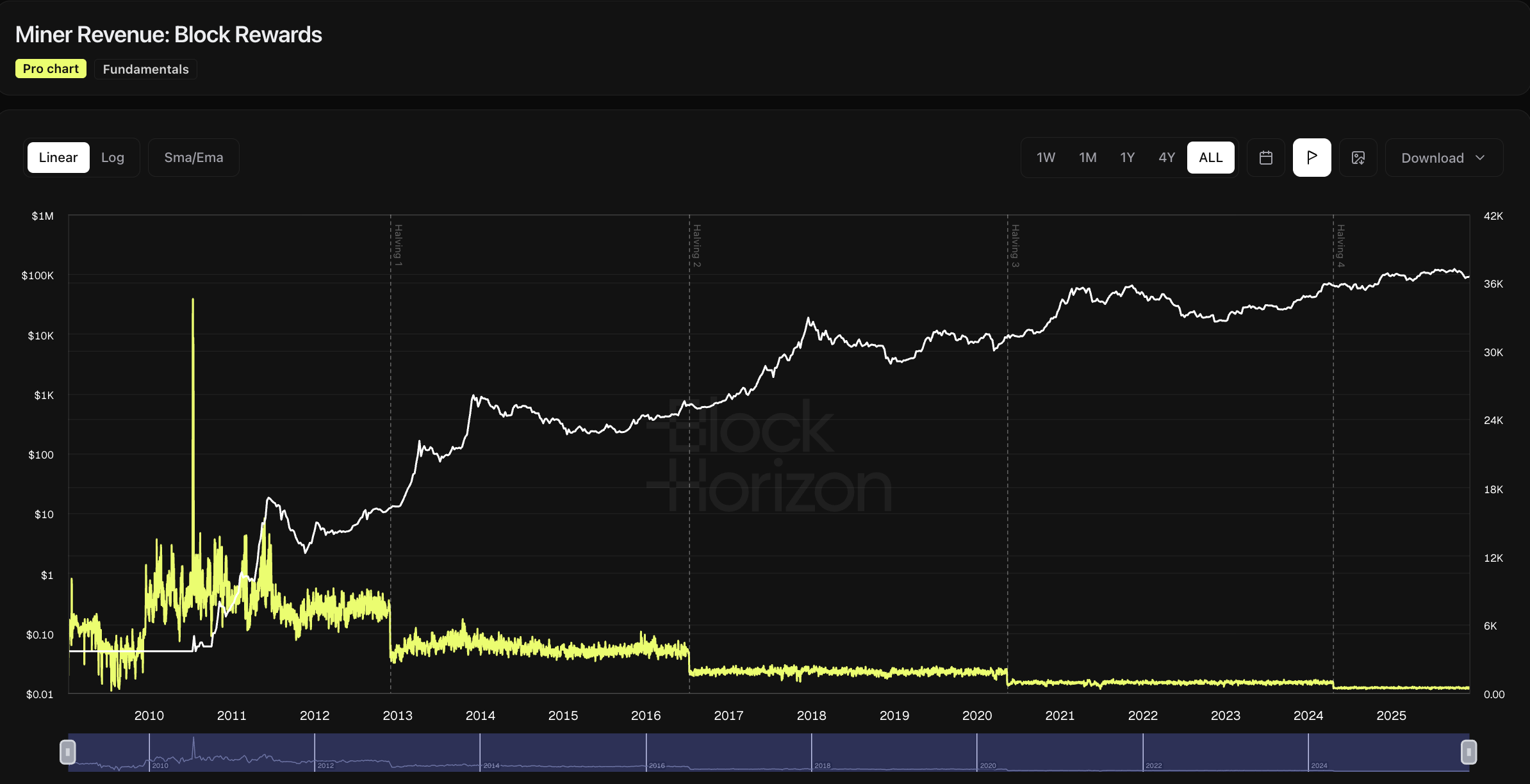
Miner Revenue (Block Rewards) Indicator (Chart Tutorial)

This chart tracks miner earnings from block subsidies only — no transaction fees included.

Why does that matter? Because block rewards are the core security budget of Bitcoin. They pay miners to show up, run machines, burn electricity, and protect the network. When rewards change, miner behavior changes — fast.

This indicator helps you:

  • Understand miner incentives
  • Visualize halving-driven revenue shocks
  • Assess long-term network sustainability
  • Track security dynamics across market cycles

If you care about Bitcoin beyond price candles, this is required reading.

What Are Block Rewards? (Simple Definition)

Let’s keep this simple.

  • Every time a miner finds a valid block, they receive a block reward
  • This reward consists of newly minted BTC only
  • Transaction fees are not included here
  • The block reward is cut in half roughly every 4 years (the halving)

Key insight: In Bitcoin’s early eras, block rewards are the primary reason miners stay profitable.

What Does Miner Revenue (Block Rewards) Measure?

This metric measures:

  • The total BTC earned by miners from block subsidies
  • Over a defined period (daily, weekly, etc.)
  • Excludes transaction fees entirely

Why that matters:

  • Higher revenue = stronger miner incentives
  • Strong incentives = higher hash rate
  • Higher hash rate = more secure network

This chart is effectively a real-time view of Bitcoin’s issuance-based security budget.

Why the Miner Revenue (Block Rewards) Metric Matters

Here’s why this chart deserves your attention:

  • Shows how dependent miners are on block subsidies vs fees
  • Visualizes the economic cost of attacking Bitcoin
  • Makes halving impacts impossible to ignore
  • Helps anticipate miner stress, shutdowns, or consolidation
  • Critical for understanding long-term sustainability

Big picture insight: Bitcoin is slowly transitioning from a subsidy-driven network to a fee-driven one — and this chart shows every painful step of that transition.

How to Read the Block Reward Revenue Chart

High Block Reward Revenue

Typically means:

  • Strong miner profitability
  • High miner participation
  • Rising hash rate
  • Strong network security
  • Favorable price conditions before or between halvings

This is when miners thrive.

Low Block Reward Revenue

Usually signals:

  • A post-halving subsidy cut
  • Pressure on miner margins
  • Inefficient miners shutting down
  • Growing dependence on transaction fees
  • Temporary security stress

This is where weak operators get flushed out.

What to Watch Closely

  • Sharp revenue drops immediately after halvings
  • Long-term downtrend in issuance
  • Revenue recovery driven by price increases
  • Divergences between miner revenue and hash rate
  • Stress periods during low-price environments

What High Miner Revenue (Block Rewards) Means

High block reward revenue usually indicates:

  • Strong issuance-based income
  • Healthy and competitive mining environment
  • High hash rate supported by incentives
  • Lower probability of miner capitulation
  • Strong overall network security

Context matters: Miners are in the best position when price and block subsidies align.

What Low Miner Revenue (Block Rewards) Means

Low revenue typically indicates:

  • A recent halving shock
  • Miners operating on thin margins
  • Older or inefficient hardware being shut down
  • Mining power consolidating among efficient operators
  • Rising importance of transaction fees

Insight: Low subsidy revenue doesn’t kill Bitcoin — it forces efficiency.

Understanding Miner Incentives & the Security Budget

Block rewards are the foundation of Bitcoin’s incentive model.

Early on:

  • Block rewards = most miner income
  • Security budget is massive

Over time:

  • Rewards shrink
  • Security budget shrinks unless:
    • Price rises
    • Fees increase
    • Mining efficiency improves

Simple Example

  • Before a halving: ~900 BTC/day issued
  • After a halving: ~450 BTC/day issued
  • That’s an instant 50% revenue shock

This chart makes those moments impossible to miss.

Historical Patterns in Block Reward Revenue

Bull Markets

  • BTC price rises
  • Block reward revenue explodes
  • Miner profitability surges
  • Hash rate hits all-time highs
  • Network security strengthens

Bear Markets

  • Price falls
  • Revenue contracts sharply
  • Some miners capitulate
  • Hash rate growth slows or dips

Halving Cycles

  • Revenue is cut in half overnight
  • Short-term miner stress
  • Long-term price appreciation usually restores profitability

How Traders & Analysts Use This Metric

Real-world use cases include:

  • Assessing miner profitability and stress
  • Anticipating miner capitulation risk
  • Evaluating Bitcoin’s security budget
  • Tracking post-halving economic adjustments
  • Comparing issuance revenue vs fee growth
  • Estimating potential miner sell pressure

This metric is especially powerful when paired with hash rate, difficulty, and fee revenue.

Limitations of the Block Rewards Indicator

Be honest with the data.

This metric:

  • Does not include transaction fees
  • Is highly sensitive to BTC price
  • Doesn’t show miner operating costs
  • Can’t explain sentiment on its own

Always combine it with:

  • Hash rate
  • Miner fees
  • Total miner revenue
  • Mining difficulty

Pro Tips for Using the Block Rewards Chart

  • Always compare pre- vs post-halving revenue
  • Overlay hash rate to identify miner stress
  • Use long-term averages to reduce noise
  • Combine with fee revenue for full context
  • Watch for extreme drops → capitulation zones
  • High reward periods = peak security conditions

Frequently Asked Questions (FAQ)

1. What does Miner Revenue (Block Rewards) measure?

Total BTC earned by miners from block subsidies only.

2. Why does revenue drop after a halving?

Because block rewards are cut by 50% roughly every four years.

3. Does this metric include transaction fees?

No. It tracks issuance only.

4. How does BTC price affect miner revenue?

Higher price can fully offset declining subsidies.

5. Can low revenue cause miners to shut down?

Yes — inefficient miners often exit during stress periods.

6. Is high block reward revenue good for Bitcoin?

Generally yes. It supports strong security and participation.

7. Will block rewards eventually reach zero?

Yes — around 2140. Fees will then dominate miner revenue.

👉 Explore the Miner Revenue (Block Rewards) dashboard

About author
,
Back to top

Build with BlockHorizon

Get started with BlockHorizon today and unlock the
full power of the Bitcoin Blockchain
Talk to our team