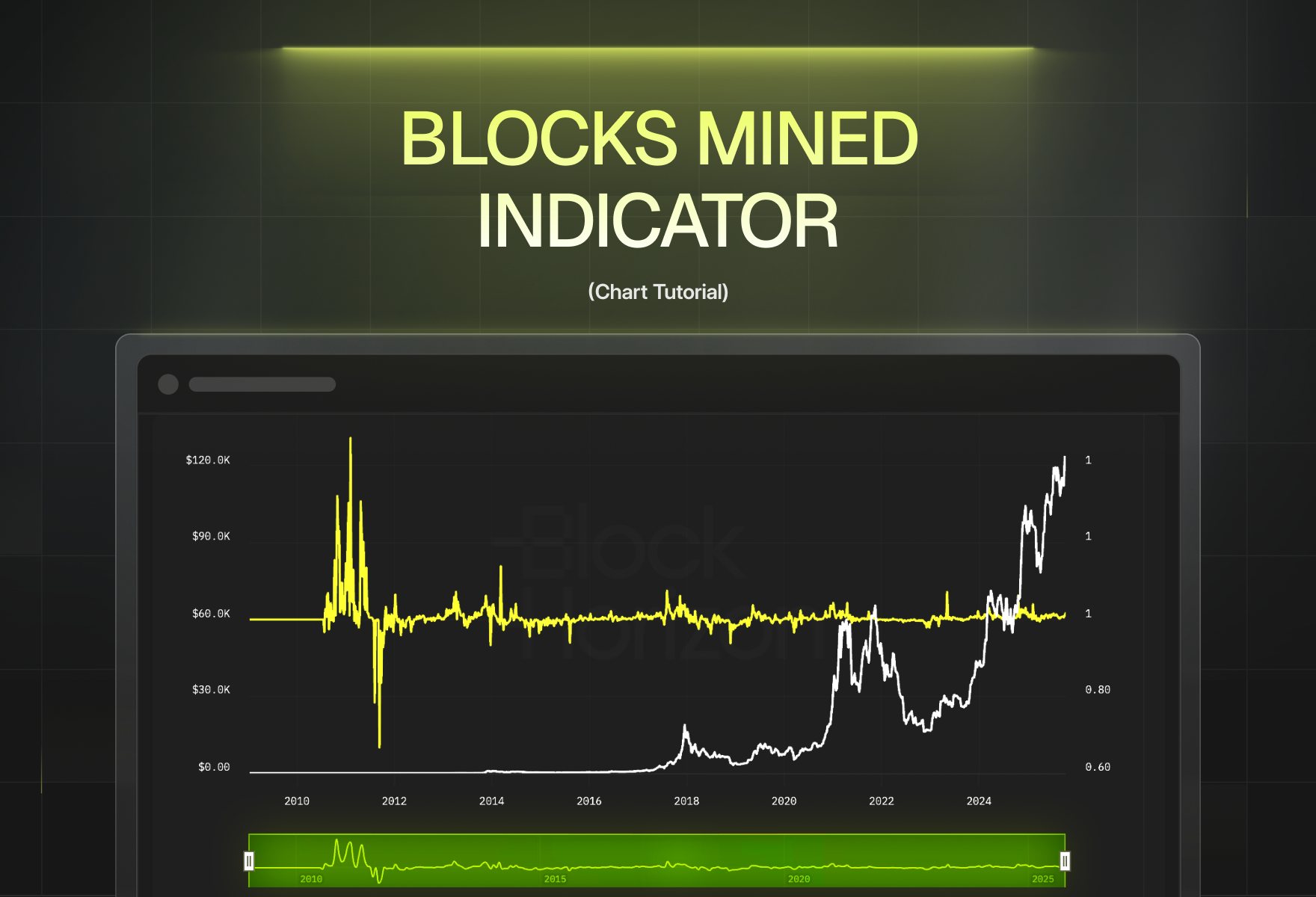
Powered by Block Horizon proprietary Bitcoin datasets.
TL;DR
Blocks mined measures block production over time.
It reveals network health, mining participation, and difficulty shifts.
It’s one of the most useful metrics for halving analysis and miner behavior insights.
Bitcoin’s “blocks mined” metric looks simple at first — it’s literally the count of how many blocks miners produced over a period. But the story behind those numbers? That’s where the insights live. The Blocks Mined chart on BlockHorizon shows you whether the network is healthy, stressed, growing, or reacting to market events in real time.
If you want to understand miner behavior, network security, or the lead-up to each halving cycle, this chart is one of your best tools.
What Is the Blocks Mined Metric? (Simple Definition)
The Blocks Minedmetric tracks the number of Bitcoin blocks successfully mined within a specific timeframe — daily, weekly, monthly, or custom periods.
This metric reflects:
How active miners are
How strong (or weak) network participation is
How quickly blocks are being discovered
Whether the network is operating as expected
Key points:
Every new block contains a fresh set of confirmed transactions.
A healthy Bitcoin network produces around 144 blocks per day, on average.
When block counts deviate from expected ranges, something important is happening — difficulty shifts, miner migrations, halvings, and more.
Blocks mined is one of those underrated metrics that tells you what’s really happening behind the scenes, especially during volatile periods.
Why Blocks Mined Matters for Bitcoin Analytics
If you care about the Bitcoin network beyond just price action, this metric becomes essential. Blocks mined is a direct proxy for how well the network is performing.
Here’s why it matters:
1. It Shows Network Uptime & Performance
If blocks are being mined consistently, Bitcoin is functioning smoothly. If block production drops sharply, Bitcoin is signaling stress.
2. It’s a Strong Indicator of Mining Participation
Higher block production → miners are very active
Lower block production → miners are exiting or struggling
It’s one of the best signals of how much hash power is online.
3. Helps Detect Short-Term Anomalies
This chart often reveals issues before they show up anywhere else:
Network slowdowns
Difficulty overshoots
Miner shutdowns
Congestion
Orphan block spikes
4. It Correlates With Halving Cycles and Market Activity
Blocks mined often behaves erratically around halvings:
Pre-halving → miners push hash power to maximize final high-reward era
Post-halving → older mining machines shut down
Difficulty then adjusts and stabilizes the network
Pretty much every halving has a signature “block production wobble” visible on this chart.
How to Read the Blocks Mined Chart on BlockHorizon
Here’s how to actually use the chart without overthinking it.
The chart displays:
Blocks mined per selected timeframe (daily/weekly/monthly)
Deviations from expected block production (~144/day)
Historical block production levels
Context for difficulty adjustments
How block production relates to price cycles and upcoming halving events
If you use this chart while watching difficulty, block times, and hash rate together, it becomes one of the most powerful real-time signals on BlockHorizon.
What a High Blocks Mined Rate Means
When blocks mined exceed expected levels, something interesting is happening. Bitcoin aims for ~10-minute blocks, but hash power doesn’t always cooperate.
Indicators of high block production:
Strong mining participation. New miners or new hardware is coming online.
Hash rate is rising. More computing power leads to shorter block times (until difficulty catches up).


.jpg)